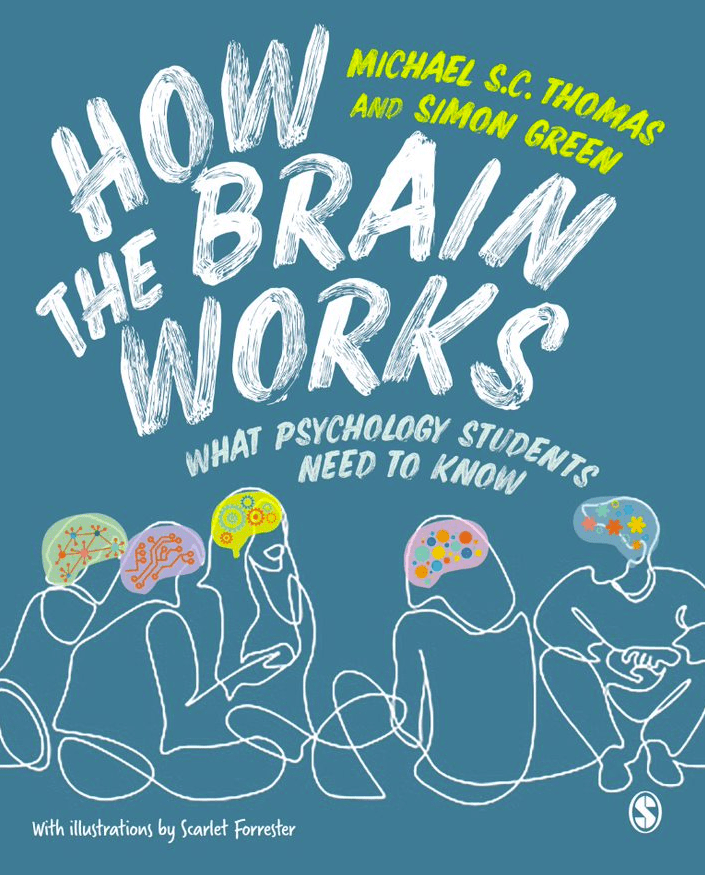
The book is published by Sage and available for order at Sage, Amazon, Barnes&Noble.
Delve into the intricacies of the human mind with this engaging and insightful guide to how the brain works. See here for an interview with the authors in the Psychologist magazine about what makes this book different to all those other textbooks…
This book is intended to give psychology students a basic understanding of how the brain works, and why the brain shows the kinds of properties it does. It sets the functioning of the brain in a biological and evolutionary context, and provides the foundation for more advanced studies in cognitive neuroscience and biopsychology. Written in an accessible and light-hearted style, the book covers the main introductory material of how neurons work, the components of the brain, and how they fit together. An original feature of the book is a sustained emphasis on how behaviour reflects the interaction of systems within the brain; content-specific systems such as action selection, memory, emotion and value, and modulatory control systems. It highlights current challenges in the field, such as the ethics of neuroscience, and whether we can and should enhance cognition.
It also addresses such crucial questions as how something as complex as a neuron could have evolved, why the brain has been put on back to front, how the brain can tell if it’s happy, how it’s awards ceremonies that mark humans out as a special species, why all the other human species went extinct, and how to use what we know about the brain to save the world (at least, from climate change).
The book is an essential read for undergraduate psychology students.
Meanwhile, this website hosts supporting material for the book, as well as additional resources, links, and comedy outtakes…
Tour by chapter:
Chapter 1. Introduction (and some puzzles)
Chapter 2. Where the brain comes from: evolution
Chapter 3. What are the bits of the brain and what together do they do?
Chapter 4. How does a neuron work?
Chapter 5. The brain is a computer, obviously
Chapter 6. The brain is a biological organ, not a computer
Chapter 7. How it gets to work this way: development and learning
 How the Brain Works - What Psychology Students Need to Know
Leave a comment